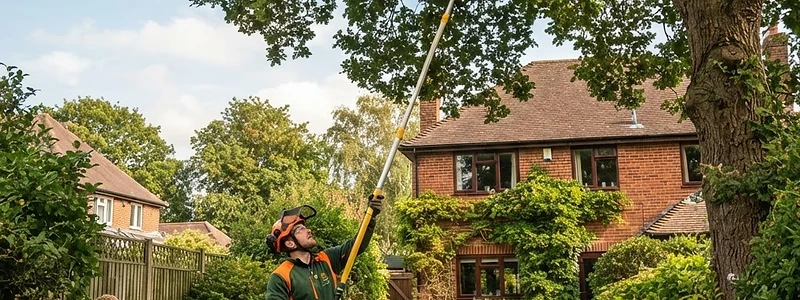
A long tree pruner is one of the most useful tools a homeowner can own for keeping trees and large shrubs in check. But there is a clear line between what a pole pruner can safely reach from the ground and what needs a qualified tree surgeon with ropes, a harness and the right insurance. This guide covers where that line sits, how to use a long tree pruner safely, and when to put it down and call us.
What is a long tree pruner? Pole pruners, telescopic loppers and pole saws explained
A long tree pruner is any cutting tool mounted on an extendable pole that lets you reach branches from the ground without a ladder. The three main types are pole pruners, which use a rope-operated bypass cutting head, telescopic loppers, which are a longer-handled version of garden loppers, and pole saws, which carry a curved pruning saw blade on the end of a pole. Some tools combine a cutting head and a saw in one.
We use professional versions of these tools every day, but the ones you buy from a garden centre or DIY shop are built for lighter, occasional work. They are useful, and they have clear limits. Knowing where those limits sit is the difference between a tidy prune and a call to us with a branch through a greenhouse roof.
The key distinction is between a cutting head, which works like a pair of scissors, and a saw head, which cuts with teeth. A bypass cutting head is quick and clean on green wood up to a certain thickness. A saw head is slower but handles thicker and dead wood. Most homeowners benefit from having both options, either as separate tools or as a combination pole with a head on one side and a saw on the other.
How high does a long tree pruner actually reach?
Most domestic long tree pruners extend to between 3 and 5 metres. Add your own height and arm reach, and you are cutting at roughly 4 to 7 metres from the ground. That sounds generous, but a mature oak, beech or conifer in a Surrey garden will often carry its canopy at 8 metres or higher.
Telescopic poles are the key variable. A two-section pole gives you around 3 metres of reach. A three-section pole can push to 4.5 or 5 metres. Beyond that, the tool becomes heavy, unwieldy and hard to control, which is the last thing you want when you are cutting above your head.
The honest answer is that a long tree pruner handles the lower canopy. Anything above that line is a job for a climber or a mobile elevated work platform, and that is where we come in. If you can see the branch clearly and reach it comfortably with the pole at full extension, you are within the tool's range. If you are stretching, straining or craning your neck to see the cut, you are at the limit.
What thickness of branch can you cut with one? (bypass loppers vs pruning saw heads)
A rope-operated bypass cutting head will typically cut branches up to about 30mm in diameter. That is roughly the thickness of a broom handle. Telescopic loppers with longer handles can push that to 40 or 50mm if the wood is green and soft, but they struggle on older, harder wood.
A pole saw head has no fixed diameter limit in the same way, because it cuts with teeth rather than a scissor action. In practice, you can saw through branches of 75 to 100mm if you have the patience, the strength and a secure angle. Beyond that, the blade binds, the pole flexes, and the cut becomes dangerous.
The rule we work to is simple. If the branch is thicker than your wrist and above shoulder height, a pole saw from the ground is marginal. If it is thicker than your forearm, it is beyond what a domestic tool should attempt. A branch that size, falling from 5 metres, carries enough weight and momentum to injure someone or damage property below.
Manual, telescopic or petrol/battery pole pruner: which suits your garden
For light, occasional pruning of small branches, a manual telescopic pruner is perfectly adequate. It is quiet, light, and needs no fuel or charging. If you have a few fruit trees or a small ornamental tree, this is all you need.
For a garden with several mature trees, a battery-powered pole pruner offers more cutting power and less fatigue. The battery adds weight at the handle end, which helps balance the tool, but you are still limited by reach and branch thickness. Battery life is a factor: a single charge will typically last for 30 to 45 minutes of active cutting, which is enough for a session but not for a full day's work.
Petrol pole pruners are serious tools. They cut faster and handle thicker wood, but they are heavy, loud, and need regular maintenance. For most homeowners in Woking, Guildford or Weybridge, a petrol pole pruner is more tool than the job requires, and the weight makes it harder to control safely at full extension. They also produce emissions and require fuel mixing, which adds a layer of upkeep most domestic users do not want.
Buying checklist: reach, weight, locking mechanism, blade type and handling
If you are buying a long tree pruner, here is what we would check before parting with your money:
- Reach: Look for a tool that extends to at least 3.5 metres. Shorter poles limit you to the lowest branches and leave the higher work to us.
- Weight: Under 2.5kg for a manual pole, under 4kg for a battery model. Heavier tools are harder to control overhead and tire your arms fast.
- Locking mechanism: Cam locks or flip locks are more reliable than twist locks, which can slip under load and drop the pole to a shorter length mid-cut.
- Blade type: A bypass cutting head for green wood up to 30mm, a pruning saw head for thicker or dead wood. Some tools offer both on the same pole.
- Handling: Check the grip and the balance point. A top-heavy tool will tire your arms quickly and make the cut harder to place accurately.
[CONFIRM: specific brand or model recommendations, if the business wishes to endorse any]
How to use a long-reach pruner safely from the ground
Start by clearing the area below the branch. Anything that can be damaged by a falling branch, be it a greenhouse, a car, a fence or a person, needs to be out of range. We rope off areas on site for exactly this reason, and so should you.
Stand to the side of the branch, not directly beneath it. Angle the pole so the cutting head meets the branch at a natural working angle, usually between 45 and 60 degrees from vertical. Let the tool do the work: a sharp bypass head cuts on the pull, and a pole saw cuts on the pull stroke too. Forcing the cut bends the pole and risks a kickback.
Wear safety glasses. Falling debris, sawdust and small twigs come down in a wider radius than most people expect. Gloves with grip are essential, because a sweaty or slippery handle is hard to control at full extension. Check above and behind you for overhead power lines before you extend the pole, and keep well clear of any cables.
Why you should never use a long pruner from a ladder
This is the single most common way DIY tree pruning goes wrong. A long tree pruner is designed for ground use. Adding a ladder changes the geometry completely. You are now holding a long, heavy pole while standing on an unstable platform, and the cutting action introduces a sideways force that can easily tip you off.
The Health and Safety Executive is clear that working at height with cutting equipment requires proper training and equipment. For professional tree work above ground level, we use ropes, harnesses and sometimes a mobile elevated work platform, never a domestic ladder with a pole pruner.
If the branch is beyond your reach from the ground, that is the signal to stop and call a qualified tree surgeon. It is not the signal to fetch a step ladder. The risk is not worth the saving.
Making the right cut: pruning that protects the tree's long-term health
A good pruning cut sits just outside the branch collar, the slight swelling where the branch meets the trunk. Cutting too close removes the collar and slows healing. Cutting too far away leaves a stub that dies back and invites decay. For a deeper guide on this, see our tree pruning service page.
For larger branches, use the three-cut method to prevent the bark tearing. Make a small undercut first, about 100mm from the final cut position. Then cut from the top, slightly further out, to remove the bulk of the branch. Finally, make the finishing cut just outside the branch collar. This is the technique we use on every tree reduction job, because bark tears are the most common cause of long-term decay after pruning.
When to prune: best times of year for trees and hedges in the UK
Most deciduous trees are best pruned in dormancy, between late November and late February, when the sap is down and the tree is not under stress. This is the standard advice from the Royal Horticultural Society. There are exceptions: cherries and plums should be pruned in summer to avoid silver leaf disease, and some ornamental species have specific timing needs.
Hedges are different. Hedge trimming is typically done in late spring or late summer, depending on whether the hedge is formal or informal. A formal hedge may need two cuts a year to stay sharp and neat.
If you are unsure about the species or the timing, ask. We advise on this across Surrey and South West London throughout the year, and a quick call costs nothing.
Before you cut: TPOs, conservation areas, boundaries and overhanging branches
Before you cut anything, check whether the tree is protected. A Tree Preservation Order, or TPO, makes it an offence to cut, top, lop, uproot or wilfully damage a protected tree without council consent. Conservation areas give similar protection to all trees above a certain size. You can check for TPOs on the gov.uk website.
Overhanging branches are a common source of neighbour disputes. In principle, you can cut back branches that cross your boundary to the boundary line, but you should offer the cuttings back to the tree owner, and you must not damage the tree. If the tree is protected, the normal consent rules apply regardless of the overhang.
This is where a qualified tree surgeon earns their fee. We handle the council applications, advise on what is permitted, and make sure the work is done legally and correctly. If you are in a conservation area in Cobham, Woking or Godalming, we can tell you within a phone call whether consent is needed.
Five jobs a long tree pruner can't do, and what a tree surgeon uses instead
- Crown reduction on a mature tree: Reducing the overall height and spread of a large tree requires climbing or a platform, and precise cuts to selected branches. A pole pruner from the ground cannot do this safely or well.
- Removing a whole tree: Tree removal involves sectional dismantling, rigging, and controlled lowering of heavy timber. No domestic tool can do this.
- Large deadwood removal: Dead branches high in the canopy are often brittle and unpredictable. We remove them with specialist deadwood removal techniques, using ropes to lower each piece safely to the ground.
- Stump grinding: Once the tree is down, the stump needs a grinder. A pole pruner is irrelevant here.
- Pruning near power lines: This is legally restricted work. Only qualified arborists with the right certifications may work within proximity of overhead lines.
Deadwood, storm damage and hazardous branches: leave these to a qualified team
Storm damage is where we see the most DIY attempts go wrong. A branch that has partially failed and is hanging in the canopy is under tension and compression that is impossible to read from the ground. Cutting it in the wrong place can release stored energy violently, and the branch will fall where gravity and tension take it, not where you want it to go.
Deadwood is similar. A dead branch that has been in the tree for months may have rotted at the attachment point and may not fall cleanly. It may drop pieces as you cut it, or it may break before you finish the cut. Either way, the result is unpredictable and dangerous.
If you have storm damage or hazardous deadwood, do not reach for a pole pruner. Call a qualified, insured team. We carry full public liability cover, and we have the rigging equipment to bring heavy timber down in a controlled way, even over a roof, a driveway or a glasshouse. The first step after a storm is to keep people away from the area, take a photo for your insurance, and call us to assess the situation safely.
Getting professional help in Surrey and South West London
We are JBF Tree Surgery, a qualified, insured and trusted team working across Surrey and South West London. From Woking to Guildford, Cobham to Weybridge, we handle everything a long tree pruner cannot reach: tree pruning, tree reductions, deadwood removal, hedge trimming, tree removal and stump grinding.
You can see our recent work on our hedge reduction project in Oxshott and Leatherhead, read what our clients say on our reviews page, and learn more about the team on our about page. For an idea of pricing, our tree surgery cost guide covers the main factors that affect the price of a job.
If the branch is out of reach or over a roof, fence or driveway, get a free, no-obligation quote from JBF Tree Surgery. We are a qualified, fully insured team with [CONFIRM: exact public liability cover amount] public liability cover, working across Surrey and South West London. Just call for a chat, or reach us through our contact page.