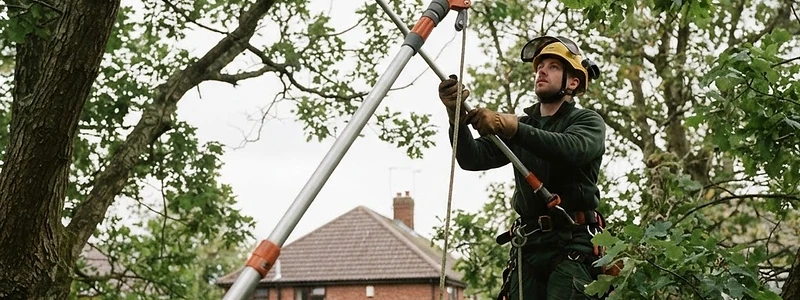
What is a long tree pruner? (and what are long-handled pruners actually called)
A long tree pruner is any cutting tool with an extended handle that lets you cut branches from ground level instead of climbing. Shops sell them as long-handled pruners, long-reach pruners, telescopic tree pruners, pole pruners, pole saws and tree loppers, and the names are used loosely. Two products that look similar can be very different tools.
They all do the same thing: put a cutting head on a pole so you can reach branches above your head. What changes is the head, the pole length and whether the pole extends. A bypass lopper on a short handle is not the same tool as a four metre pole saw, and neither replaces proper climbing and rigging.
For a homeowner in Woking or the surrounding towns, the useful question is not what it is called. It is whether it can make a correct cut on the branch in front of you.
The main types: loppers, pole pruners, telescopic pruners and pole saws
Four types cover almost everything sold as a long tree pruner.
Long-handled loppers. Two handles and a bypass or anvil blade, usually 60cm to 1.2m long. They cut stems up to roughly 25mm to 40mm, with good leverage and a clean cut, but they are not a height tool.
Pole pruners. A pruner head on a fixed pole of 1.8m to 3m, worked by a rope, pull rod or lever. Simple, light and reliable when you already know the height you need.
Telescopic pruners. The same idea with an extending aluminium or fibreglass pole, reaching around 3m to 5m on domestic models. Convenient, but the further you extend, the more flex you introduce, and flex spoils cuts.
Pole saws. A curved pruning saw blade on a pole, fixed or extending, and sometimes a chainsaw head. They cut timber a lopper cannot, but they remove material by sawing, so technique matters more.
How long is a long tree pruner? Typical reach and the real working height
Manufacturers quote the length of the tool. The number that matters is cutting height, and it is always lower than the figure on the box.
Add your own reach to the pole length, then allow for the angle. A 3m pole held at 45 degrees puts the head about 2.1m above your hands, not 3m. Add around 1.8m for your reach and the cutting height is nearer 3.9m than the 4.8m the arithmetic suggests.
Then allow for control. A pole at full extension whips, and a moving blade does not cut cleanly. Most homeowners work comfortably at 3m to 4m and struggle above that. Anything higher belongs with someone who can climb or work on a rope.
So when a product claims 5m of reach, read it as 5m of pole, less reach, less control and a cut you will have to fight for.
What jobs a long-reach pruner does well
Used within its limits, a long tree pruner is genuinely useful, and some jobs are better done from the ground.
Light formative pruning of young fruit trees: thinning a crowded crown, removing a crossing shoot, tipping back a leader. Suckers and watershoots on a clear stem. Small dead twigs in the lower canopy where you can see the collar. A branch just above head height that is about to become a bigger problem. A few low laterals so you can mow under the tree.
It is also handy between proper visits, for a shoot growing into a path or a light limb over a border. For the reasoning behind each cut, see our tree pruning service.
Jobs a long tree pruner can't do properly
The failures are predictable, and they usually start with a limb heavier than the tool was designed for.
Anything needing a controlled drop. Once a limb has weight you need a saw and a plan. A pole pruner that bites into a thick limb and stalls leaves you holding a heavy branch above your head with no way to lower it.
Cuts where you cannot see the branch collar. A correct cut stays outside the collar, the swollen area where branch meets stem. From 5m below you often cannot see it, so you cut in the wrong place and the tree seals the wound badly.
Reductions and crown work. Reducing a crown means cutting back to chosen laterals, which is a decision made up close. From the ground you tip the tree instead, and tipped trees respond with a flush of regrowth. This is tree reduction work, and it is climbing work.
Anything over a roof, greenhouse, conservatory or boundary. If the piece cannot fall where you are standing, the tool is wrong.
Work on a tree you cannot identify. Some trees bleed badly if pruned at the wrong time, some decay readily after a large wound, and some are protected.
How to make a clean cut with a pole pruner without damaging the tree
Three things decide whether a cut heals well: position, sharpness and steadiness.
Position. Aim for the branch collar and cut just outside it at a slight angle away from the stem. Do not cut flush and do not leave a long stub. Get your eye line close to the cut and rest the head against the branch to steady it.
Sharpness. A blunt blade crushes rather than slices, and crushed tissue is slower to seal. Sharpen or replace the blade and stop forcing the tool when it struggles.
Steadiness. Cut with the blade supported, not swinging. Hook the head over smaller stems so the branch resists the cut. On a saw head, start a groove underneath, then cut from the top to reduce tearing when the limb drops.
For anything bigger than a secateur would manage in one bite, the safer sequence is an undercut, then a top cut slightly further out, then a final cut to the collar. Doing that neatly at height with a pole is difficult, which is a fair sign the branch is beyond the tool.
If a cut will be larger than you can make cleanly, stop. A ragged wound in the wrong place stays with the tree for life.
Safety: working overhead from the ground, power lines and ladders
Most pole pruner injuries come from falling timber, or from a tool touching something it should not.
Wear a helmet with a chin strap, eye protection and gloves. Never stand directly under the branch you are cutting. Work from the side, plan where the piece will land, and keep people and pets out of the drop zone. Check above you for cables before you raise the pole.
Power lines are a hard stop. Metal and carbon fibre poles conduct, and even fibreglass has limits. The HSE guidance on working at height sets out what planning overhead work requires, and the HSE advice on chainsaw and arboricultural work is largely about position and control.
Ladders are the other common mistake. A ladder, a pole pruner and a moving branch give three points of instability at once. If the branch cannot be reached from the ground, the answer is a climber, not a taller ladder.
Check for a Tree Preservation Order or conservation area before any structural cut. The government guidance on Tree Preservation Orders and conservation areas explains what needs consent, and pruning that is routine in one garden can need an application next door.
Deadwood, hedges and conifers: matching the tool to the task
Different work needs different tools, and a pole pruner is only one of them.
Deadwood. Small dead twigs in the lower canopy are reasonable. Larger dead limbs are not, because dead wood can drop without warning, can shatter, and gives no feedback through a pole. Substantial deadwood belongs with a climber on a rope. See our deadwood removal service.
Hedges. A pole pruner is the wrong tool for a hedge. A hedge needs a straight line and a consistent face, which comes from a hedge trimmer and a line. On tall hedges the practical answer is a powered trimmer on a long shaft or a proper reduction. Our hedge trimming service covers both, and this hedge reduction in Oxshott shows a tall boundary being handled.
Conifers. Most conifers will not regrow from old wood, so a cut into bare interior growth leaves a permanent gap. A pole pruner encourages exactly the tipping that ruins leylandii and conifer hedges. If a conifer is too tall, the realistic options are a proper reduction to a growing point or removal.
When to stop and call a qualified tree surgeon
Here is the short version. Stop when any of these is true.
The branch is out of reach at full extension. The limb is too heavy to control. The piece cannot fall safely near a roof, fence, shed, boundary or road. You cannot see the branch collar. The tree is dead, dying, storm damaged or leaning. The tree may be protected. There is any cable within reach. You would need a ladder to get closer.
None of that is a reflection on you. It is simply where a different set of skills takes over: climbing, rigging, lowering, and sometimes a conversation with the council before any cut is made.
A bad cut is also permanent. The cost of a qualified opinion is far lower than the cost of a wrecked crown, a damaged roof or an insurance claim.
How JBF Tree Surgery handles high pruning in Surrey and South West London
We work across Woking, Guildford, Weybridge, Cobham, Camberley, Godalming, Leatherhead and the surrounding Surrey and South West London area. High pruning is a normal part of what we do, and it is not done from a pole unless a pole is genuinely the right answer.
Every job starts with an assessment: what the tree is, what condition it is in, what you want from it and what the site allows. We check for Tree Preservation Orders and conservation areas before work is agreed, and where consent is needed we help with the application.
On the day we climb and rig where that is the correct method, lower timber rather than dropping it, and protect lawns, borders, paths and boundaries. All brash, timber and chippings are cleared before we leave. You can read more about how we work.
If you are unsure whether a branch is a pole pruner job or a climbing job, send us a photo and ask. We will tell you honestly, even when the answer is that you can do it yourself.
If the branch is out of reach of your pole pruner, contact JBF Tree Surgery for a free, no-obligation quote from a fully insured, NPTC City & Guilds qualified team.